Frontaer is an evolving motorcycle brand. We may earn affiliate fees on some pages of this site. Read more.

Motocross vs Supercross: What Is The Difference?

It looks like Motocross and Supercross are awfully similar, but they aren’t. There are clear and distinct differences:

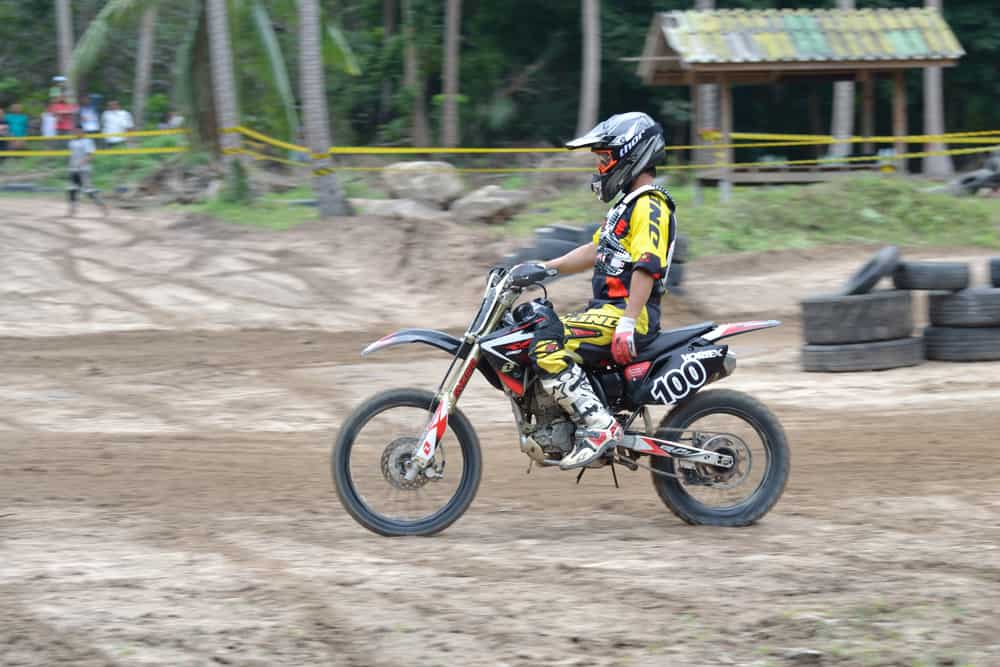
Motocross differs from supercross in that motocross in that motocross riders ride on longer tracks and gain higher speeds, while supercross focuses around stuntwork in stadiums. A motocross track may require the rider to ride for up to 2 miles before finishing a lap, while a supercross track is much shorter between 500 and 750 yards, with many jumps and tabletops to impress the spectators.

Of the two types of dirt bike racing disciplines, motocross is much more popular. In order for riders to get involved in supercross professionally, they need to compete at a stadium while motocross simply requires a dirt track, of which there are thousands in the world.

Motocross Compared to Supercross

It’s understandable to get confused between these two types of racing classes. After all, they both use dirt bikes on well-groomed tracks with audiences watching on.

Similaries

Yes, they share many of the same elements when it comes to riding competitively.

The similarities are:

  • Professional riders. Both are done by professional racers covered by an industry body paired with many spectators. These are a seasonal series where competitors race just about every weekend for a set period of the year to accumulate points.
  • Types of dirt bikes. Both use 450cc and 250cc dirt bikes, and smaller classes are available for children and teenage riders. Common dirt bikes include those made by Yamaha, Honda, KTM, Suzuki and Husqvarna.
  • Riding style. Riders are expected to ride aggressively on the track and push through past the slow riders. You won’t see any mirrors on their dirt bikes which means there is a high risk of injury.
  • Engine type. Most commonly, competitors choose to use 2-stroke dirt bikes due to increased torque and a more aggressive powerband, though 4-strokes are becoming quite popular. They will also have a race team to help them with mechanical issues and repairs.

You’ll also find a loyal fan base between each disciplines of racing. Many famous riders actually compete in both to mix things up a little in their career.

Differences

This is probably what you’re looking for: What is the difference between the two types of racing?
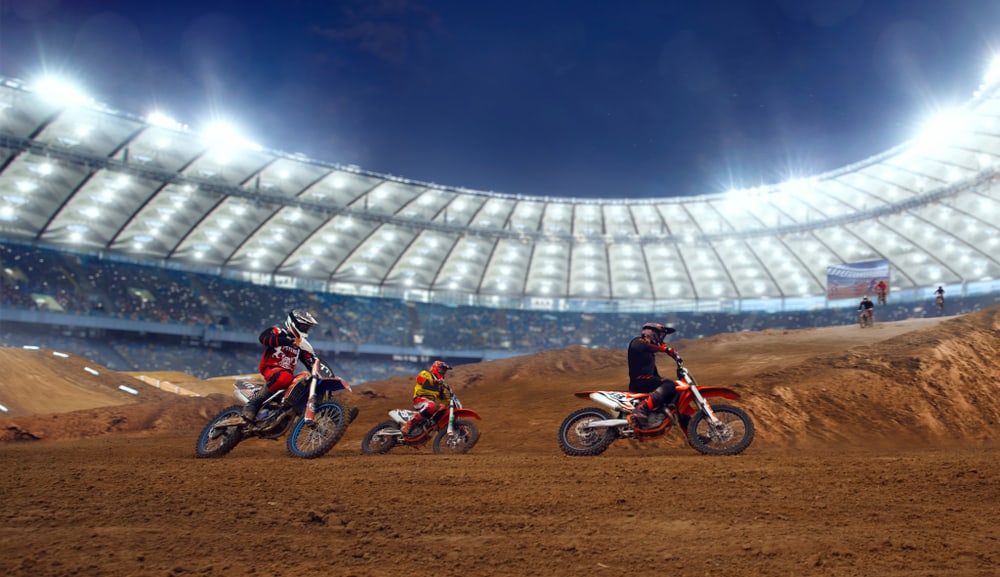
Well, the differences between supercross and motocross are quite straight forward:

  • Location variances. Supercross events are almost always held in stadiums for all-weather performances, with racing done in the evening under the bright lights. Kids love supercross because of the cool tricks that the riders do.
  • Time of Day. Motocross events can be held anytime day and night, with riders often competing in the morning or afternoon on an open motocross track.
  • Performance and Speed. The average speed of a supercross dirt bike competitor is much slower than one on an MX bike because of the track design. Long sweeping tracks compared to small man-made stadium tracks.
  • Stuntwork. Motocross tracks do have jumps but the main focus is on speed and performance as opposed to seeing motorcyclists doing stuntwork.
  • Race Length. Motocross riders do ride for a longer time period because the track is much longer. Sometimes a competitor could be out there for 2 to 3 hours (like a mini-enduro) before finishing up on a race with long sweeping corners and fast-flowing whoop sections, while a supercross rider is there for the aggressive cornering and jumps.
  • Terrain. Supercross riders enjoy flat terrain while motocross riders may, in some instances, experience some elevation changes depending on the track location.

One could say that supercross is a scaled-down version of motocross, with a greater emphasis on entertaining the crowd rather than actually winning tournaments. Now, a scaled-down version of supercross is called arena cross, and then there are trials and hard enduro which is another discipline of riding entirely.

Final Thoughts

It’s fair to say that the differences between the two aren’t that major and many families enjoy watching both types of racing. If you have children, then they’re going to enjoy the supercross events more and given they’re held in stadiums with roofs, you often won’t be rained on in the evenings.

Continue Reading More Guides by Frontaer

[elementor-template id="4784"]

👉 39 Most Common Dirt Bike Terms (How Many Do You Really Know?)

🔥 21 Awesome Dirt Bike Riding Tips ('Cause We Want You Safe Out There!)

🌲 How To Go Camping With Your Dirt Bike (And Arrive Home Safely)

🔧 7 Tools Every Dirt Bike Rider Must Carry (To Avoid Those Awkward Rescue Calls)

🥾 Best Dirt Bike Boots That Go The Distance (Who's Got The Best for 2021?)

Why Do Dirt Bikes Have Upside Down Forks?

Have you noticed those dirt bikes racing around on the tracks and trails while their forks are inverted? There is a clear reason:

Upside down front suspension forks on a dirt bike allow the front end to be stiffer. Riders using inverted forks are then able to have greater responsiveness in their steering and this leads to better cornering, as well as better handling in whoop sections. As a result, there is reduced stiction between the lower and upper halves of the fork.

There is a lot of engineering jargon and technical reasons why dirt bike riders choose to modify their dirt bikes like this, but Frontaer will try to keep things simple.

Fitting Dirt Bikes with Upside Down Forks

Having inverted forks has sound engineering principles, but do you really need it? Well, if you’re riding a dirt bike, then it really depends on your riding style. Most commonly you’ll find riders choosing to reverse their forks on their road motorcycles as opposed to dirt bikes.

If you’re the type that wants to win championships or take the lead in a recreational group ride, then you’re going to be pushing yourself behind the limits of your forks. This is when you’re going to move up from amateur to professional, and as a race bike, you’re going to want forks. The same can be said for adventure motorcycles who need to be stiffer in the front end to cater for the additional weight of camping gear and additional fuel.

The rigidity can far outweight the cost, but it still depends on your riding style and type of motorcycle, as well as your weight. For those who love to claim some airtime, the suspension lifecycle will be enhanced through inverting the forks in most cases.

To invert them, you can often get this done yourself or get a mechanic to go through the process. This will cost you $200 or if you do it yourself, 2 to 3 hours of your time on the weekend.

Disadvantages of Inverted Forks

While many sing the praises of inverted forks, and they certainly do have their advantages, there are some downsides too. This is why you won’t see them on most dirt bikes, despite the riders knowing of their upsides.

The disadvantages include:

  1. Challenging to Service. If you’re riding often and clocking up the miles, then you’ll be servicing your dirt bike just as often. The services on the fork seals will be challenging, especially as you won’t have a drain on your upside down fork. How are you going to release the oil? Certainly you’re going to need some assistance there and mechanics themselves have a tough time with this task.
  2. A Hazard to Braking Systems. When your fork seals let themselves go, then you can have a genuine issue on your hands. With upright forks, a leaking fork seal isn’t too hazardous and you can ride it out until you get back to the trail head or finish your race since gravity is on your side. With a USD fork, this is very much a case of gravity working against you. Given the location of the fork seal (directly above the front brake assembly), all that fluid is most likely going to end up on your front pads and tyre.
  3. The upfront cost. To transfer from upright to inverted front suspension forks requires time and patience, with some extra help if you’re not mechanically inclined. If you’re not happy with the handling or the dangers that it poses, then you’ll spend additional time reverting it back.

Now – don’t let us scare you here. Thousands of dirt bike riders would only get behind the handlebars if their forks were inverted already given the advantages.

Closing Thoughts

You really have to weigh up the cost. It’s very debatable among the dirt bike riding groups on Facebook, but one thing is for sure – they certainly do make your suspension a little tougher but aren’t without the risks.

Continue Reading More Guides by Frontaer

[elementor-template id="4784"]

👉 39 Most Common Dirt Bike Terms (How Many Do You Really Know?)

🔥 21 Awesome Dirt Bike Riding Tips ('Cause We Want You Safe Out There!)

🌲 How To Go Camping With Your Dirt Bike (And Arrive Home Safely)

🔧 7 Tools Every Dirt Bike Rider Must Carry (To Avoid Those Awkward Rescue Calls)

🥾 Best Dirt Bike Boots That Go The Distance (Who's Got The Best for 2021?)

Can A Dirt Bike Become Turbo-Charged?

Have you been curious about the future of dirt bikes and fitting a turbo on to the engine? Sounds exciting, but why haven’t they done it?

Well, our findings over the last 10 years are quite straight forward.

Dirt bikes don’t need turbo chargers in order to perform well and often perform worse with the rear tire spinning too aggressively for the dirt. It’s also not commercially viable for manufacturers like Yamaha, KTM and Honda to fit turbos on to their dirt bikes, even for motocross or enduro racing. There are some prototypes and home-made versions with turbo-chargers, but nothing has developed in the mainstream market.

Many riders get too excited about the power prospects and don’t realize that their machine is fast enough already. If you don’t have enough power, the best way to achieve these outputs is to actually go up in engine size or to switch to a race-ready manufacturer like KTM.

Turbo-Charged Dirt Bikes

Fitting a turbo on a dirt bike just simply isn’t something that you need. Dirt bikes just don’t have the space capacity to get a turbo fitted, unlike the engine bay of a car. Space really is at a premium there and you’d have to reduce your fuel tank size among other things to even stand a chance.

We’ll also add in the fact that dirt bike turbos also weigh about 100lbs or 30kgs. That’s a lot of weight already for a dirt bike to haul around. So any power gains you’re looking to achieve would mostly be taken up by this additional weight, as well as the lack of space availability.

Probably the most common reason why this doesn’t work out well for the rider is the crazy amount of torque. It’s much like electric dirt bikes where their torque can be so excessive in that you simply lose traction. If your goal is to increase your acceleration speeds, then these gains may not eventuate with a turbo as you simply can’t get enough weight on that rear tire to keep it from breaking ground.

AMA and Motocross Rules

The American Motorcyclist Association Motocross Division is unlikely to ever approve the notion of turbo-charged dirt bikes in events. Generally, once something has sudden successful time in any racing season, that same thing is rolled out into mainstream dirt bikes through stores across the country.

Thus, the biggest lead in taking these mainstream is also the biggest hindrance. Yet that hindrance is justified for the reasons outlined above – it hasn’t been done because it isn’t feasible commercially at scale. If KTM or Yamaha saw a future here, then they’d invest a few million which they haven’t yet. That’s a tell-tale sign.

Dirt bikes in both the recreational and competitive landscape are built for linear power delivery. Turbos aren’t linear and thus, riders would be frustrated pretty quickly in the constant breaking of traction. Yep, we’ve said that twice now.

In Summary

You’re unlikely to ever see turbo dirt bikes in a commercial sense anytime soon. Yet it isn’t actually wishful thinking here. Go on YouTube and you’ll find some good examples. If you did want this done to your dirt bike, then some service operations do exis.

Then again, you can find some used dirt bikes with turbo models on Craigslist and Gumtree, but the gains from these machines are questionable. Most commonly, the rider/owner has regretted their decision.

As they are, dirt bikes do already run exceptionally well, with 4-strokes coming a long way in the last 10 years to become the bike of choice for many motocross riders. With electric dirt bikes being the way of the future, we naturally aspirated dirt bikes continuing to shine until the lights of such factories are switched off.

Continue Reading More Guides by Frontaer

[elementor-template id="4784"]

👉 39 Most Common Dirt Bike Terms (How Many Do You Really Know?)

🔥 21 Awesome Dirt Bike Riding Tips ('Cause We Want You Safe Out There!)

🌲 How To Go Camping With Your Dirt Bike (And Arrive Home Safely)

🔧 7 Tools Every Dirt Bike Rider Must Carry (To Avoid Those Awkward Rescue Calls)

🥾 Best Dirt Bike Boots That Go The Distance (Who's Got The Best for 2021?)

Luciano Benavides – The Legendary KTM Team Rider

Luciano Benavides is an Andalucia Rally competitor who has crashed on mutliple occasions, yet has achieved some remarkable wins.

In this English guide, we’ll help you better understand this rally raid competitor.

Let’s begin.

Luciano Benavides

Luciano is a Dakar Competitor and is known internationally to compete alongside his brother, Kevin Benavides. They’re seriously quick when riding side by side at a million miles per hour. They are known among the commentators as ‘THe Benavides Brothers’ given how much each shares the same passion.

Luciano generally rides a KTM 450 Rally and is with the Red Bull KTM Factory Team. Pair this with 6D Helmets and Alpinestars apparel, and you’ve got a competitor who can outperform most others. In the Dakar, he choses to have #16 bike.

Luciano happens to be one of the youngest riders in the Dakar Rally at age 23. He grew up racing motocross in Argentina and those skills have certainly transferred to the desert sands.

Riding for Rockstar Energy Husqvarna Factory Racing

Recently, Husqvarna Motorcycles has annouced the signing of Luciano. Certainly he’ll be much needed in the Abu Dhabi Desert Challenge as well as the RIM Cross-Country Rally.

He’s becoming ever more prominent and seriously which in the open country. Luciano isn’t as known for crashing or sustaining broken bones from accidents. Perhaps this is something to be said about his young age, and indeed, something that the brand would’ve been happy have on the team.

Future Plans

We do look forward to seeing Luciano taking a spot on the Dakar Rally in future years. Clearly the COVID-19 Pandemic has altered some rally competitions at this point in time.

What we know for sure is that there is no stopping this rider. He’s 10 years into a 25 year career and clearly loves the game. That is: Going fast and winning championships.

We’ll be watching this one closely.

Continue Reading More Guides by Frontaer

[elementor-template id="4784"]

👉 39 Most Common Dirt Bike Terms (How Many Do You Really Know?)

🔥 21 Awesome Dirt Bike Riding Tips ('Cause We Want You Safe Out There!)

🌲 How To Go Camping With Your Dirt Bike (And Arrive Home Safely)

🔧 7 Tools Every Dirt Bike Rider Must Carry (To Avoid Those Awkward Rescue Calls)

🥾 Best Dirt Bike Boots That Go The Distance (Who's Got The Best for 2021?)

Best Rear Paddle Tires for Dirt Bikes in Sand (2023)

Dirt bikes can travel in sandy conditions, but it’s best if they have a rear paddle tire fitted. The type that can propel you hard.

Frontaer has done the research as we like riding our dirt bikes in sand. It’s seriously run…provided you can keep that right hand twisted and not let off when the front gets a little woobly.

Best Dirt Bike Rear Paddle Tires

You only need a tire for the rear given that the front is pretty well light when you’re riding. Your knees actually steer the bike while your hands keep your controls in check.

Let’s jump straight into business here. These are the best rear paddle tires for dirt bikes:

1. Sedona Dunatik

The Dunatik is a serious offroad weapon for your dirt bike. It’s light yet aggressive at the same time, and design to really dig down into the sand with the paddles, yet allow your dirt bike to float enough on the surface. Getting bogged down will be a thing of the past, even in the sandiest of riding areas.

2. Maxxis Cheng Shin Surge P Tire

We’ve always been a real big advocate of Maxxis here at Frontaer. They are a brand that has brought quality to the offroad with for years, and it’s no different with the Surge P. This tyre is well known among the hardiest of dirt bike riders for its ability to allow you to glide effortlessly across the sand.

3. CST Cheng Shin Surge P Tire

This CST happens to be almost identical to the Maxxis tire above. Why is it different? Well, these brands run OEM so one sells to the other under a different name. With both brands, you’ll get 8 paddle scoops to blast you across at high speeds without needing to sink down so much or even lean back to find some traction. The compound used in these tires is less likely to chunk away when exposed to gnarly rocks either.

4. Vee Rubber Paddle Radial Tire

Vee Rubber isn’t as well known in the offroad motorcycling world, and their reviews are minimal. That said – they do provide a good tire which is more affordable and is designed to last a few seasons out there in the soft stuff. We’re waiting for Vee Rubber to get back into stock at this time of writing.

5. Kenda K760 Dual/Enduro Rear Motorcycle Bias Tire

The last on our list isn’t quite a paddle tire but one worthy of consideration. Kenda has brought this tire to the market which has some seriously chunky knobs where it can be ridden on the sand and the hard stuff too. With paddle tires, you’re likely to chunk your tire and wear it out within a few miles but this tire lets you keep riding and riding. It doesn’t perform as well on the sand, nor the road, but when you’re trying to get a tire that at least gets you through both terrains, then this is the one you’ll want.

Getting started

There you have it out fellow dirt bike riders! Some very good options for heading out there and exploring the sand dunes.

Just remember some safety considerations:

  1. Always have a spotter at the top of sand dunes. Let’s admit it: You don’t want to be a dork with a sand flag on your dirt bike.
  2. Keep that power on. Even with a rear paddle tire, your dirt bike needs your constant power to keep you ploughing through the sand. You’ll need to lean back as well.
  3. Avoid steering too much. Instead of steering, you should be leaning while letting the front tyre go where it wants to. You’re unlikely to crash, but even if you do….well it’s just sand!
  4. Consider your mileage. Riding through sand really chews up the gas pretty quickly, so don’t ride out too far. Ensure you have a few litres on reserve and remember that the life expectancy of your dirt bike paddle tire is only around 2,000 miles at best.

Continue Reading More Guides by Frontaer

[elementor-template id="4784"]

👉 39 Most Common Dirt Bike Terms (How Many Do You Really Know?)

🔥 21 Awesome Dirt Bike Riding Tips ('Cause We Want You Safe Out There!)

🌲 How To Go Camping With Your Dirt Bike (And Arrive Home Safely)

🔧 7 Tools Every Dirt Bike Rider Must Carry (To Avoid Those Awkward Rescue Calls)

🥾 Best Dirt Bike Boots That Go The Distance (Who's Got The Best for 2021?)